THE NINETEENTH SUNDAY AFTER TRINITY – REFLECTION
‘When Jesus saw their faith, he said to the man, ‘Take heart, son; your sins are forgiven.’ Matthew 9:2
Brothers and sisters, we live in a world where we have easy access to solutions to many of our problems. Problem: my glasses have broken. Solution: there is an optician over the road. Problem: I have a weeds growing in my garden. Solution: the garden centre will have weed killer. Problem: I have a toothache. Solution: the dentist will have it out in no time. In our modern Western society solutions are easily available; all you need is to identify the problem, identify the person who can solve it, and then—for the right price—the solution will be quickly given. It reminds me of that annoying children’s ditty from the show ‘Bob the Builder’ I’ve never seen it, but still I know the song: ‘Bob the Builder, can he fix it; Bob the Builder, yes he can’. Broken glasses, can the optician fix it?: yes he can. Weeds growing in my garden, can the garden centre fix it?: yes he can. Toothache, can the dentist fix it?: yes he can. Identify the problem. Identify the fixer. Pay your money, and Bob’s your uncle. Can he fix it? Yes he can.
In our readings this morning, the writer of Holy Scripture points out a problem, and also points us to a solution. However, it is a problem most people haven’t even identified in themselves, and so most people never look for the solution. What makes it harder for us to identify the problem, is that the word the bible uses for this illness, is a word we don’t really use any more, and if we do, it tends to be used in ways other than how Jesus used it. The word—the problem—Jesus tells us is sin. We thought about this a bit when we studied Genesis chapter 3. The truth is that inside of us there is a fatal flaw. Each one of us is broken, each one of us instinctively ignores God and therefore each one of us messes up again and again. As one Christian priest put it: ‘In other words, sin is not some secret shame, but a feature of our common humanity […] it is part of all of us […] properly understood original sin is Christian language for human nature.’ This is bad news to be sure, but when we understand it like that, it is deeply liberating. The world around us is selling us a lie that we’re perfect, or that if we try hard enough we should be able to be perfect. That if something bad happens, it’s never our fault, we’re just victims. So, if we identify this problem at all, it is in other people. However, the truth—which we all know deep down inside—is that we’re not perfect; and when that imperfection becomes clear to us—because of the lie the culture is telling us— we feel like faulty and failed human beings. So, the first thing we have to do, says Jesus, is to own up to not being perfect. To identify having this fatal flaw in us that causes us to ignore God, and try to do things our own way. Just as our glasses will only be fixed if we recognise that they are broken in the first place, it is only when we identify our problem that we can look for a solution, not just for those people out there, but for us in here.
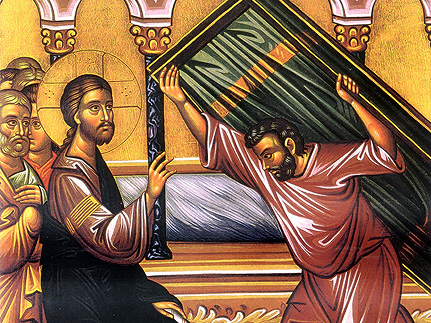
Okay, so we’ve made a good start, we’ve identified the problem: that we’re all broken, that in the language of the Scriptures we’re all sinners. Now having identified the problem, our Gospel reading goes on to show us the solution (Matthew 9:1-8). Verse 2, of the Gospel, says: ‘Some men brought to him a paralysed man, lying on a mat. When Jesus saw their faith, he said to the man,‘Take heart, son; your sins are forgiven.’’ The Gospel presents Jesus as the solution. Like the optician was a solution for broken glasses; like the garden centre was a solution for weeds; like the dentist was the solution for tooth ache, so says Jesus, He is the solution for the problem of sin, and what’s more, He is willing to give us the solution for free! This claim is astonishing, and frankly outrageous if it had come from anyone else. If you harm someone with poisonous words, only they can forgive you, no one else can say ‘don’t worry it’s ok’, and sin doesn’t just harm people it also offends God. Jesus is claiming to be able to stand in God’s place and do what only God can do: forgive sins. In effect, Jesus is claiming to be God. No wonder everything kicks off in the Gospel reading. Verse 3: ‘At this, some of the teachers of the law said to themselves, ‘This fellow is blaspheming!’’ The teachers of the law know their stuff, and they rightly come to the only possible conclusion, that Jesus is claiming to be divine. The penalty for blaspheming is death, and if Jesus is just a man then He IS blaspheming and the religious leaders are absolutely right! However, though teachers of the law have understood Jesus’ words right, they have got who He is very wrong. Many of you will know, that I’m a a fan of the author of the Narnia chronicles, CS Lewis. Lewis was a wonderful Christian writer, and he explains the issue of who Jesus is very well. Who is Jesus? Lewis wrote boldly when he said:
“I am trying here to prevent anyone saying the really foolish thing that people often say about [Jesus]: ‘I’m ready to accept Jesus as a great moral teacher, but I don’t accept his claim to be God.’ That is the one thing we must not say. A man who was merely a man and said the sort of things Jesus said would not be a great moral teacher. He would either be a lunatic—on the level with the man who says he is a poached egg—or else he would be the Devil of Hell. You must make your choice. Either this man was, and is, the Son of God, or else a madman or something worse. You can shut him up for a fool, you can spit at him and kill him as a demon or you can fall at his feet and call Him Lord and God, but let us not come with any patronising nonsense about his being a great human teacher. He has not left that open to us. He did not intend to.”
What Lewis is saying comes back to this statement in the Gospel. Either Jesus is a Liar: He knows He can’t forgive sins but says He can; or Jesus is a lunatic: He thinks He can do God’s job but He can’t; or finally Jesus is Lord: He says He can forgive sins because He is God and He can. In our Gospel reading today, Jesus has claimed—by saying He can forgive sins—that He is God, and if He isn’t—whether He is a liar or a lunatic—He deserves—according to God’s own law—to die. However, before the religious leaders can pick up stones to enact the obvious penalty, Jesus shows He is who He claims to be. Verse 5: ‘[Jesus said] Which is easier: to say, “Your sins are forgiven,” or to say, “Get up and walk”? But I want you to know that the Son of Man has authority on earth to forgive sins.’ So he said to the paralysed man, ‘Get up, take your mat and go home.’ Then the man got up and went home.’ Only God can heal a paralysed man, and only God can forgive sins. In showing that He has the power to work the miracle people can see, Jesus demonstrates He has the power to work the miracle people can’t see. In healing the paralysed man, Jesus shows He is God, and, therefore, can forgive sin. Liar, lunatic, or Lord? The crowds immediately work it out, verse 8: ‘When the crowd saw this, they were filled with awe; and they praised God’ Sin is our biggest problem. Can Jesus fix it?. Yes He can!
Friends, this morning we’re challenged by Jesus. Not only to recognise that we’re all sinners, but also to decide who Jesus is. Who do you say Jesus is: liar, lunatic, or Lord? If He is a liar or a lunatic, then He deserves no more attention than any other liar or lunatic. But, if He is Lord—that is God Himself—and He has the solution to our biggest problem, then He deserves not only our undivided attention, but also our undivided praise. What’s more, if Jesus is God and can forgive sin, then it doesn’t matter who you are or what you’ve done; no one is too good, everyone has this problem; no one is too bad, Jesus can heal anyone. So, bring your sins to Jesus—whoever you are—and you will be healed. Can Jesus fix it?: Yes He can! Amen.(from Fr Mike).

 All Saints Church Chorley