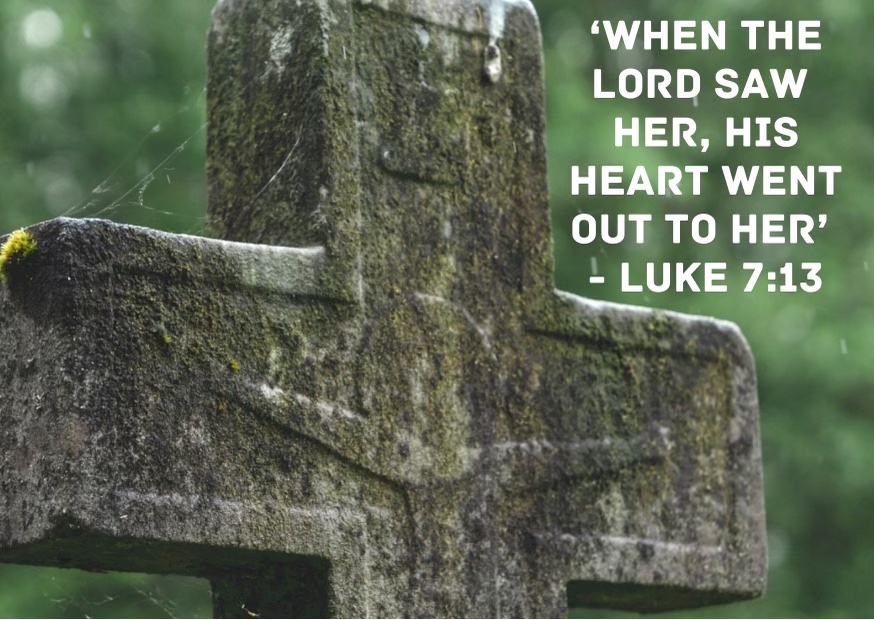
When the Lord saw her, his heart went out to her’ – Luke 7:13
Brothers and sisters, there are many places in the world where death is an ever present reality. Places like the Ukrainian battlefields, like the hospitals and homes of Third world nations where death is always showing its’ face. In the West we tend to hide it away; we tend to pretend that death doesn’t exist. However, during the last month death has been unavoidable whenever we turned on our TVs, especially in our nation. The death of HM The Queen forced all of us to acknowledge death and the certainty that it will come for each one us. And, if I may be so bold, death begs honest answers to honest questions: Where is God in death? Does He care, and why doesn’t He act. The woman in our first reading (1 Kings 17:17-24) is asking exactly these questions:
‘Some time later the son of the woman who owned the house became ill. He grew worse and worse, and finally stopped breathing. She said to Elijah, ‘What do you have against me, man of God? Did you come to remind me of my sin and kill my son?’
‘Why has God let this happen?’ she cries to God’s prophet, ’Does He care, is He powerless?’ Perhaps you know the feeling! It is these questions which our readings this morning look squarely in the face. In our first reading, death takes away a mother’s only son, and it is one of God’s followers who has to answer the questions. As a priest—a very visible member of God’s family today—I can attest that this reaction still happens today. When tragedy strikes people, understandably, want answers! What answer can we give to the question ‘Does God care?’ We should answer emphatically, yes! The lady’s son is dead; God cares a great deal; and God’s prophet, Elijah, knows this, v20:
‘[Elijah] cried out to the Lord, ‘Lord my God, have you brought tragedy even on this widow I am staying with, by causing her son to die?’ Then he stretched himself out on the boy three times and cried out to the Lord, ‘Lord my God, let this boy’s life return to him!’ The Lord heard Elijah’s cry, and the boy’s life returned to him, and he lived.’
Notice here three things, three truths which every Christian should grasp: First, pray. Prayer is given to us by God as a means to help us at all times, but especially at times of difficulty. When you face questions from those who are mourning, turn first to the Lord in prayer, knowing that He will listen and He will guide you to know how to answer those who question you. Second, notice that it is ok to ask God the tough questions: ‘[Elijah] cried out to the Lord, ‘Lord my God, have you brought tragedy even on this widow I am staying with, by causing her son to die?’’ Elijah doesn’t pussyfoot around with God. God is big enough, He can take it! Tell Him the truth, and speak from the heart. Pour out your feelings to Him; for when you are weak, when you are helpless, when you have nowhere to turn, God will listen. Now of course, those first two truths may be very well. Maybe we do pray, maybe we do speak truthfully about our difficulties, but our main questions are still to be answered. Does God care? Is He powerless? The immediate response of God in our first reading this morning, answers both of questions, v22: ‘The Lord heard Elijah’s cry, and the boy’s life returned to him, and he lived.’ God cares, and He has the power to act. The boy is resurrected, and is returned to his mum. Our third truth from this passage is profoundly reassuring for all those who have lost a loved one, or who—for whatever reason—have come face to face with their own mortality. God is more powerful even than death, and the One who has the power cares deeply for those who face their end. Maybe you are in mourning now; maybe you are watching a loved one fade away; maybe you lie in bed a night wondering about your own life. If this is you know that God is with you, He cares, and He has the power to act. You do not have to face death on your own, and you do not have to fear death for One who loves you has the power to overcome it.
As we turn from our first reading to our Gospel reading (Luke 7:11-17), then, we are already well placed to answer our main questions. However, in our Gospel reading we are drawn even closer and more reassuringly into God’s truth and love, as we see in Jesus God face to face. You see—as we know—Jesus is not just another prophet but God come to earth, and so when Jesus wants to act He doesn’t need to pray like Eljiah, He doesn’t need to ask God to act, He is God, and so He performs the miracle Himself. With this truth in mind look at the true story in the Gospel of Luke. Jesus approaches a town, and going in the opposite direction is a tragic procession to a grave. Here there is no expectation here no one asks for help, the boy is dead and—terrible though it is—the family have accepted it. Like the woman in our first reading the death of this woman’s son is tragic on so many levels. Again, she might be asking our questions: ‘Does God care? And does He have the power to act?’ Look now at verse 13:
‘When the Lord saw her, his heart went out to her and he said, ‘Don’t cry.’ Then he went up and touched the bier they were carrying him on, and the bearers stood still. He said, ‘Young man, I say to you, get up!’ The dead man sat up and began to talk, and Jesus gave him back to his mother.’
Jesus’ heart went out to her, God cares for this women, and His heart was moved by her situation. Does God care: absolutely! However, God in Jesus, isn’t just a shoulder to cry on, He now goes on to act, He goes on to show He has the power to do something about death. Just as He did at the beginning when He created the world all God the Son needs to do is speak and life appears. ‘[Jesus] said, ‘Young man, I say to you, get up!’ The dead man sat up and began to talk’. Here is the answer to our questions and to the questions of so many we meet. The resurrection in the Gospel reading—and even more conclusively the resurrection of Jesus at Easter—show that God cares for us, and He has the power to act. Not just while He is on earth, but for all time. Our increasingly secular world has forgotten, but we Christians know that at the end of time, Jesus has promised a resurrection to life for all who follow Him. On that day, what happened to the boys in our two readings, will happen for every Christian. Jesus will call and we will sit up in our graves alive once again and able to talk. On that day—as in our readings—sons will be given back to their mothers, daughters will be given back to their fathers, and husbands and wives will be reunited. Queen Elizabeth will embrace Charles, and those Christians we bury in our Garden of Remembrance will rise and return to their families. Here is why Christians do not mourn like everyone else, for we know that death does not have the final word, and we will see those who die in Christ again someday. God waits only so more can choose to follow Him before He ends time, and brings an end to death. Does God care, yes! Does God have the power to act, yes! He has acted, and He will act again. God’s words of life will be spoken over all the faithful departed on the final day when death is finally and forever banished.
And so as you reflect on the death of the Queen, as you face the death of a loved one, and as we attend funerals, we do so as a people, we do so as a church, we do so as Christians who know for absolutely certain that death is not the end, that God cares, and that God has the power to act. Amen.(from Fr Mike).
 All Saints Church Chorley